I have researched a lot of historical fashion, but the story behind the Marie Antoinette wedding dress stopped me completely.
She was fourteen years old. Marrying into one of the most powerful royal families in the world.
And the dress she wore that day was carrying more weight than any teenager should. Not just fabric and embroidery. Politics, power, and a future nobody could have predicted.
Centuries later, people are still searching for details about this gown, and honestly, the real story is far more interesting than anything the films have shown you.
Let me take you through what we actually know.
Who Was Marie Antoinette? A Royal Fashion Icon

Marie Antoinette was born in Vienna in 1755 as an Austrian archduchess. From a very young age, her life was being shaped around diplomacy and strategic marriages.
At just fourteen, she left Austria and arrived at the Palace of Versailles to marry into the French royal family. It was a massive transition, and fashion became one of the few areas where she had real power.
She quickly became one of the most influential figures in 18th-century European court fashion. Her choices set trends across the continent, and designers competed for her attention.
Her approach to style shaped what royal bridal fashion looked like for decades. What she wore on her wedding day carried enormous weight, both politically and culturally.
The Historical Context of Marie Antoinette's Wedding

Marie Antoinette married Louis-Auguste, the future Louis XVI of France, in May 1770. She was fourteen. He was fifteen. Neither of them had much say in the matter.
The marriage was a political arrangement between Austria and France, designed to strengthen ties between two powerful empires. The wedding was not about love. It was about alliance.
Royal weddings at this time were performances of power. Everything, from the guests to the decorations to the dress, was chosen to send a message.
French court brides were expected to dress in a way that reflected the wealth and prestige of the monarchy. The pressure on Marie Antoinette's appearance from day one was enormous.
The Real Marie Antoinette Wedding Dress: What We Know

The real Marie Antoinette wedding dress was a product of the French royal court at its most extravagant. Based on historical records and written accounts from the time, it was a heavily structured gown built for ceremony.
The materials were luxurious even by royal standards. Silk brocade formed the base, and fine metallic thread embroidery covered much of the surface. Nothing about it was simple.
The design followed traditional French court bridal fashion. Wide skirts, a tight bodice, and layers of decoration that made movement difficult but visual impact enormous.
The color was consistent with bridal fashion of the era. Light ivory tones and silver-threaded silk were common choices for royal brides, symbolising purity and nobility.
Sadly, no original Marie Antoinette wedding dress survives today. Fabrics from that period deteriorate over centuries, and very few royal garments from the 1700s have been preserved intact.
Design Details of the Marie Antoinette Wedding Dress
The details of this gown tell you a great deal about 18th-century royal fashion. Every element was chosen with intention, and the craftsmanship behind it represented the absolute best of what French and Austrian textile work could produce at the time.
Fabric and Embellishment

The fabric used was high-grade silk woven with metallic threads. This combination created a surface that caught the light in a way that was impossible to ignore in a candlelit palace.
Both Austrian and French textile traditions influenced the final product. The craftsmanship reflected the diplomatic nature of the marriage itself.
The embroidery work alone would have taken skilled artisans months to complete. It was extraordinarily labor-intensive by any standard.
Silhouette and Structure
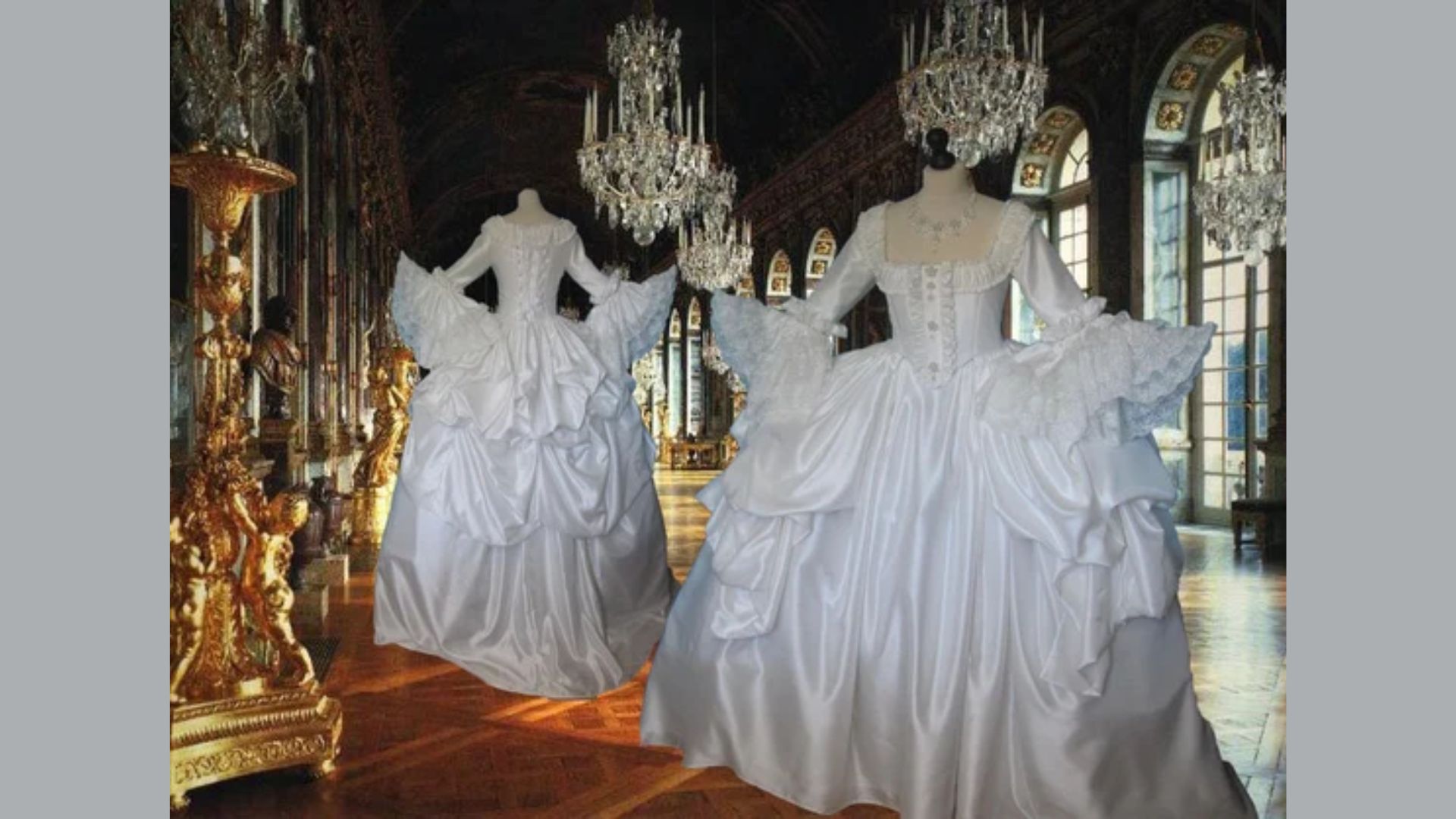
The silhouette was shaped by panniers, which were wide side hoops worn under the skirt to push the fabric out dramatically at the hips. This was the defining shape of French court fashion in the 18th century.
The bodice was tightly structured using corsetry underneath. It created a very defined waist and an upright posture that was expected at court.
The overall shape made the wearer look grand and immovable. That was entirely the point.
Decorative Elements

Lace detailing appeared at the neckline, sleeves, and hem. Fine lace at this time was extraordinarily expensive, so its presence signalled serious wealth.
Floral motifs were worked into the embroidery, which was common in Rococo-era fashion. Flowers carried symbolic meaning related to femininity, youth, and new beginnings.
Together, the decorative elements communicated purity, royal status, and the formal union of two powerful nations.
Who Designed the Wedding Dress?

There was no single named designer behind the Marie Antoinette wedding dress in the way we think of fashion designers today. That concept simply did not exist in 1770.
The gown was produced by skilled dressmakers and court tailors working within the royal ateliers at Versailles. These were highly trained craftspeople who served the court exclusively.
The fashion culture at Versailles had been heavily shaped by figures like Madame de Pompadour in the decades before. Her influence on what the French court considered stylish was still very much present.
What we do know is that the dress was a collaborative production, made by multiple hands working to meet the highest possible standard for one of the most watched royal events in Europe.
Myths vs Facts About the Marie Antoinette Wedding Dress
Films and media have created a lot of ideas about this gown that do not hold up historically. Here is a clear breakdown of what is known versus what has been exaggerated.
| Myth | Fact |
| The dress was pure white like a modern wedding gown | It was likely ivory or silver-toned silk, not modern bridal white |
| A famous named designer created it | It was made by royal court dressmakers, not a single designer |
| The original dress is stored in a museum | No original survives. Only replicas and related garments exist |
| The dress looked like the one in Sofia Coppola's 2006 film | That film used creative costume design, not historical accuracy |
| Marie Antoinette chose the dress herself | Court protocol and royal advisors heavily influenced all her wardrobe decisions |
The real Marie Antoinette wedding dress is often romanticised because of how tragic her story became. People project feeling onto the gown that the historical record cannot fully support. That does not make the real history any less interesting. It just means we need to separate the myth from the facts.
Fashion Legacy of Marie Antoinette's Bridal Look

Marie Antoinette's bridal style had a real and lasting impact on European fashion. Court dresses across France and beyond were influenced by the silhouettes and decorative choices associated with her.
The Rococo style she helped popularise, wide skirts, rich embellishment, delicate floral detailing, became the standard for aristocratic dress through the latter half of the 18th century.
Modern wedding dress designers still look to this era for inspiration. The structured bodice, the wide skirt, and the emphasis on fabric quality all echo in contemporary bridal fashion.
The cultural fascination with royal bridal looks traces a direct line back to weddings like hers. She set a standard for what a royal gown was supposed to mean.
Can We See the Original Dress Today?

The short answer is no. The original Marie Antoinette wedding dress no longer exists. Silk and brocade from the 18th century do not survive centuries without deteriorating completely.
Some museums hold surviving garments from her era, including pieces from Versailles collections and the Galliera Museum in Paris. These give a sense of the quality and style of the time, even if they are not her actual gown.
Historical replicas have been created for exhibitions and film productions. These are built using research into period techniques and materials, and some are very close approximations.
If you want to learn more about royal fashion history from this period, the Palace of Versailles and the Victoria and Albert Museum in London are both strong starting points.
Why the Marie Antoinette Wedding Dress Still Fascinates the World

Part of the reason this dress holds such a grip on people is the story attached to it. Marie Antoinette went from a royal bride at fourteen to a queen to a prisoner. The wedding dress sits at the very beginning of that arc.
Films like Sofia Coppola's 2006 Marie Antoinette and various fashion editorials have kept her image alive in pop culture. Each retelling brings new audiences to the real history.
The dress also represents something broader. It is a symbol of royal opulence, political power, and a world that no longer exists. That combination is genuinely compelling.
Search interest in the real Marie Antoinette wedding dress has stayed consistently high for years. People want to know what was real, not just what looks good on screen.
Conclusion
Few stories in history hit the way hers does.
A fourteen-year-old girl, dressed in silk and embroidery, walking into a life she never chose. That is what the Marie Antoinette wedding dress really represents when you sit with it.
Not just fashion.
A moment frozen in history that still makes people stop and ask questions centuries later.
I find that remarkable. If this story got under your skin the way it did mine, share it with someone who loves history.
And if you have questions I did not cover, drop them in the comments. I read every single one.
Frequently Asked Questions
What Did Marie Antoinette Wear for Her Wedding?
She wore a heavily structured French court gown made from luxurious silk, built according to 18th-century royal bridal standards. Written accounts describe it as rich in embroidery and decorative detail.
Does the Real Marie Antoinette Wedding Dress Still Exist?
No original dress survives today. Fabric deterioration over centuries means no intact royal garments from that period have been preserved.
What Color Was Marie Antoinette's Wedding Dress?
Historical records suggest it was ivory or silver-toned silk, consistent with royal bridal fashion of the era. It was not the bright white associated with modern wedding gowns.
Who Designed Marie Antoinette's Wedding Dress?
It was created by skilled dressmakers and court tailors working within the royal ateliers at Versailles. There was no single named designer in the modern sense.
Why Is Marie Antoinette's Wedding Dress So Famous?
It represents royal luxury, political history, and one of the most dramatic life stories in European history. That combination has kept cultural interest alive for centuries.